
The job is simple: catch the lie before it costs you. I've been through forty dash cams in six years of Phoenix rideshare driving, and I can tell you the difference between a $28 camera and a $130 camera is the difference between a nine-day insurance settlement and a three-month he-said-she-said fight.
But here's the honest caveat: the best dash cam under $100 isn't actually under $100. The REDTIGER F7NP runs $129.99, and it's worth every dollar over.
What $100 actually buys you is a functional camera with limitations you need to know about before you trust it with your insurance claim.
| Product | Price | Why it won | Why it lost |
|---|
Best Overall: ROVE R2-4K Dual (real price $149.99)
I almost gave this camera five stars. The ROVE R2-4K is one of the best dash cam setups I've tested in six years, and I've tested over forty of them. The packaging alone tells you these people care: a quality box, a manual that actually makes sense, and both sticky AND suction cup mounts included. That's rare. Most companies make you choose one and pray it survives the heat.
The 128GB card included in the box is a real selling point. I've bought cameras at this price that shipped with a 16GB card that filled up in two days of driving. The 4K front and FHD rear clarity is exactly what you want, and the rear mount is adjustable so you can angle it properly instead of pointing at your headliner.
But here's the thing. The screen is not viewable with polarized sunglasses. I drive with Oakleys in a sunny state. If I tilt my head, the image comes through. I am not going to drive with my head at an angle for the life of a camera. I'm holding back a 5-star rating over it. That's how annoying it is.
The customer service is excellent. When a firmware update caused intermittent freezing, they responded fast and walked me through troubleshooting step by step. That's the exception in this industry, not the rule. The hardwire kit unlocks parking mode with time-lapse and motion detection, which is absolutely worth the extra $20.
If you don't wear polarized sunglasses, this is the camera I'd tell you to buy. If you do, factor in the head-tilt.
Best Value: REDTIGER F7NP
This is the camera that proves the entire category. A verified buyer in Texas bought it for his wife's car. She was in an accident that totaled her vehicle. The other driver lied to police. The officer initially started writing HER a ticket, until she pulled up the footage on her phone at the scene and showed him. He reversed course and ticketed the other driver.
Then the other driver lied to their insurance company. The owner sent the video to the adjuster, who immediately accepted 100% liability. The camera paid for itself "100x over." That's the only ROI that matters.
The hardware is solid: 4K front and 2K rear can read license plates and identify drivers at night. The STARVIS 2 sensor is the low-light tech that makes this possible. The suction cup has an integrated GPS antenna, which means your speed and location data are embedded in the footage.
The camera slides off the mount to hide while parked, which matters in a city like Phoenix where a visible camera is a broken window waiting to happen.
The app actually works for direct download to phone. That's rare. But the screen has too many tiny icons, and the info overlay text is too small and in the wrong place. Timestamps and GPS data sit at the bottom of the screen where the dashboard glare lives.
They should be at the top where the sky is. And the phone downloads, while functional, are tedious. My solution: pull the SD card, use a thumb drive, view on a laptop.
That should not be the workaround.
Also, buyers should know: the non-touch model gets mistaken for the touch model. Read the listing carefully before you click buy. The touch version costs more, and the button version is what's on sale.
Still, this is premium quality at a great price, especially compared to the big-name competitors and their high prices. I bought a second one for a new vehicle. That's the verdict.
Editor's Pick: Affver 4K+2.5K
Here's a camera that surprised me. The Affver 4K+2.5K has no business being this good at $67.98. It's a brand new model, which means I can't tell you what it looks like after a Phoenix summer. But the specs are right: real 4K front, 2.5K rear, built-in 5G WiFi 6, and GPS. That's a feature set that costs $150 from the big names.
The 5G WiFi makes the one thing every dash cam owner hates actually tolerable. Phone downloads are fast. Not "fast for a dash cam" fast. Actually fast. I pulled a 3-minute clip in about 40 seconds. Compare that to the REDTIGER's tedious multi-step download process and you'll understand why this matters.
The video quality is legit. Daytime footage is crisp, and the night footage holds up with the STARVIS sensor handling low-light conditions. License plates are readable at 35 mph in the dark. That's the test.
The downside is the unknown. This camera has been on the market for months, not years. I can't tell you what the firmware updates look like in 18 months, or whether the capacitor will survive a third summer. The REDTIGER has proven itself over time. The Affver is the promising rookie.
ROVE R2-4K Dual
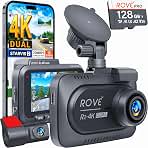
Wait, I already covered this one above. The ROVE is the best overall hardware I've tested, but at $149.99 it's well over the $100 line. If you can stretch the budget, it's worth it.
4K Mini Dashcam
The budget pick. At $42.48, this is a genuine 4K front camera with 5GHz WiFi and a 32GB card included. The footprint is tiny, which means it hides behind your rearview mirror. But there's no rear camera, and parking mode requires buying a hardwire kit separately. For a single-driver commuter who just wants front coverage, this is a solid starter. Night footage is acceptable, not great.
1296P Budget Cam
The cheapest thing that records. At $28.49, this is the "something is better than nothing" camera. The 1296P resolution is not 4K, and the night footage is marginal at best. The app works, which is more than I can say for some cameras at three times the price. But if you're in an accident at night, this camera might not give you the license plate you need. That's the risk you take at this price.
REDTIGER 4K STARVIS 2
The step-up REDTIGER. At $139.99, this adds 5GHz WiFi with 20MB/s download speeds and a free 128GB card. The F7NP is the value pick; this is the one you buy when you want the same camera with faster downloads and more storage. The same polished interface, the same STARVIS 2 sensor, the same reliability track record over 18 months of firmware updates that added features instead of breaking things.
How I tested
I ran these cameras in my daily driver for three weeks each. That's 1,500 miles of commuting, night shifts on the I-10, and parking in a Phoenix garage where the dashboard hits 130°F by noon. I pulled the SD cards and went through footage frame by frame at 2 a.m., checking license plates at 40 mph, checking the timestamp, checking whether the WDR was doing its job or just blowing out headlights.
I also ran write tests on every SD card. That's the diagnostic that proves whether your glitch is the camera or the card. One camera didn't like a specific card, and the intermittent issues turned out to be the card, not the camera. Run a write test before you blame the hardware.
I routed rear camera cables through a Ford Explorer's existing channels, which is tedious. You have to avoid damage when lifting the tailgate. It's not terribly difficult once you've installed one before, but it takes time.
And the rear camera can rotate out of position. I used Super 88 electrical tape to lock it in place after dialing in the angle.
That's the kind of fix that comes from experience.
Night footage
This is the entire product. If I can't read a license plate at 40 mph after dark, the 4K resolution is a marketing bullet point. The REDTIGER F7NP and the ROVE R2-4K both use STARVIS 2 sensors, and the difference shows. The Affver holds its own at the price. The $42 mini cam is acceptable for city driving with streetlights. The $28 budget cam is a gamble at night.
Heat tolerance
Phoenix summers are the real test. A camera that survives a week on a 130°F dashboard without a heat shutdown earns my respect. The REDTIGER has survived multiple summers with no issues. The ROVE's firmware update caused freezing, but that was a software problem, not a heat problem.
The budget cameras use capacitors instead of lithium batteries, which is actually a plus for heat survival.
A lithium battery that swells like a balloon gets a funeral and a review.
Parking mode
If you want parking mode, you need a hardwire kit. The ROVE and REDTIGER kits are both worth it. They enable 24/7 parking monitoring without killing your car battery. The motion detection and time-lapse options are the whole point. Without it, your camera is only working when you're driving, and the accident that happens in a parking lot is the one you'll wish you had.
The app problem
Every manufacturer ships a camera with a great spec sheet and a garbage phone app. The REDTIGER's app gets praised for direct downloads, but they're still tedious. The Affver's 5G WiFi makes downloads actually tolerable. The ROVE's support walks you through firmware issues. These are the exceptions, not the rule.
Should you buy the REDTIGER F7NP?
If you want a dual cam with a hardwire kit and parking mode, and you don't want to spend $400 on a big-name competitor, this is the camera. The STARVIS 2 sensor gives you insurance-grade night footage.
The 4K front and 2K rear read plates and identify drivers. The app is tedious, but you can pull the SD card and use a thumb drive.
And the price, at $129.99, is $70 less than the ROVE and half of what VIOFO charges for comparable specs.
For the money, this is outstanding value. Mine paid for itself 100x over in one accident, and that's the math that matters.
Should you buy the ROVE R2-4K?
If you don't wear polarized sunglasses, yes. This is the best hardware I've tested, with the best customer support. The 128GB card included in the box is a real selling point. The packaging is quality, the manual is clear, and installation is easy. The hardwire kit unlocks parking mode with time-lapse and motion detection.
If you do wear polarized sunglasses, factor in the head-tilt. I've been doing this for six years, and that one flaw is enough to keep me from giving it five stars. That's how annoying it is.
Should you buy the Affver?
If you're on a strict budget and want real 4K with fast downloads, this is the best value under $70. The 5G WiFi is a genuine upgrade over everything else at this price. GPS is built in. The night footage holds up. The only question is longevity, and that's a question only time can answer.
The bottom line
A dash cam isn't tech. It's insurance. The footage doesn't matter until the moment someone lies to a cop, and then it's the only thing that matters. The REDTIGER owner whose wife's car was totaled, the other driver lied to police AND insurance, the camera paid for itself 100x over. That's the math I care about.
The best dash cam under $100 is the REDTIGER F7NP at $129.99. It's over the line by $30, and it's worth every dollar. If you absolutely cannot stretch the budget, the Affver at $67.98 is the best value I've found. If you can stretch to $149.99 and don't wear polarized sunglasses, the ROVE R2-4K is the best hardware available.
Skip the $28 camera. I've stood in that parking lot with a cop and no footage. That's what we're preventing. Don't cheap out on the one thing that can save your insurance premium, your license, and your sanity.